

Every project we undertake carries change within it: not as an outlier, but as a given. Agile project management is the framework designed around that reality.
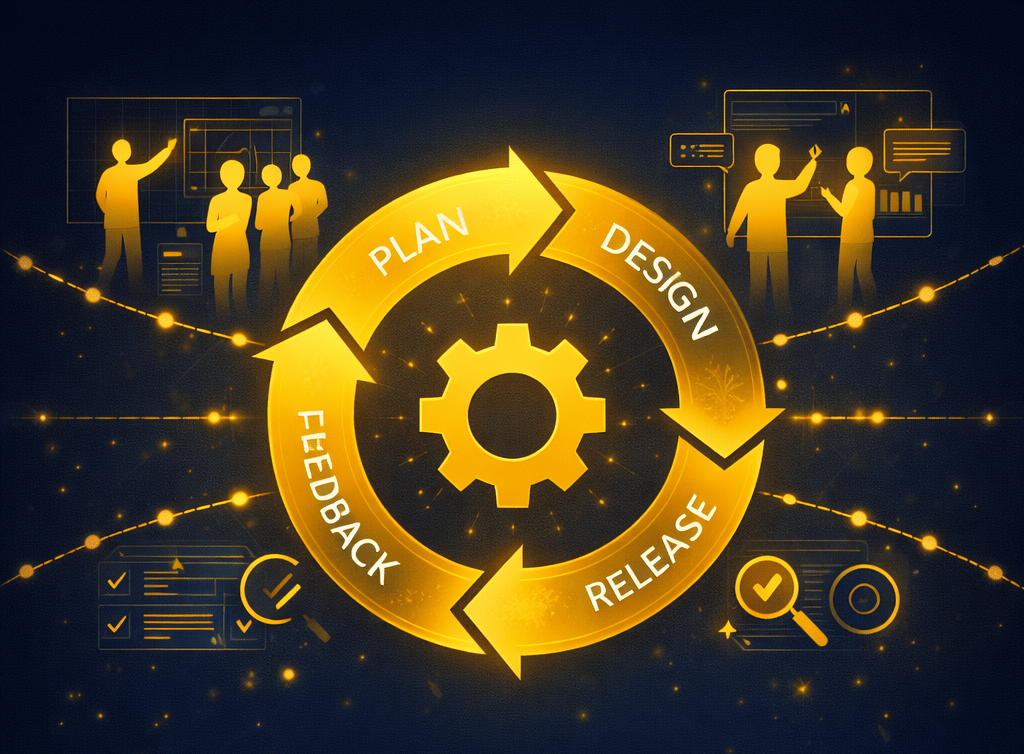
Agile project management is an iterative, flexible approach to project delivery, grounded in the understanding that change is inevitable, and that embracing it early creates a meaningful advantage.
It fits best in early-stage environments where the destination is not yet fully clear, and where reaching it depends on a steady loop of feedback and adjustment. But it also fits equally good when providing a SaaS solution; constant improvements of the service is the only way to stay relevant in the market. It is also very useful in any IoT device which is capable of firmware upgrade. In addition, Agile project management has shown to be a life-saver on the battlefields of Ukraine, with weekly – sometimes even daily – modifications to the drones used by the defenders, upending the entire defense industry’s reliance of pre-agreed scope and decade-long development cycles.
What “Agile” Actually Means
At its core, agile means staying flexible, welcoming change, and moving toward a goal through iteration rather than rigid pre-planning. It is a deliberate philosophy, shaped largely as a response to the obvious shortcomings of sequential, fixed-plan project models.
The Agile Manifesto, as published 25 years ago, states
We have come to value
- Individuals and interactions over processes and tools
- Working software over comprehensive documentation
- Customer collaboration over contract negotiation
- Responding to change over following a plan
That is, while there is value in the items on the right, we value the items on the left more.
This piece will not venture into the specifics of XP, Kanban boards or Sprint backlogs. What is worth establishing early is that the agile methodology offers structured ways of handling change, managing iterations, and systematically gathering feedback. This ensures that each step forward is backed by real information.
A Practical Baseline: The AI App
Picture a team that has just released their minimum viable product: a new AI assistant app aiming to change how people engage with technology in their day-to-day work.
Initially, the first user base is still modest after a launch on Reddit. Word of mouth is driving most of the growth. The questions that matter most at this stage are: does this product address something that existing tools do not, and will users keep coming back to it?
The answers live in the feedback of those early adopters. That is the exact environment where agile delivers its clearest value.
Agile is structured to pull in feedback at shorter intervals, fold it into the product, and keep moving
The Main Components of Agile
Five principles sit at the foundation of agile: iterative development, collaboration, flexibility, a consistent cadence, and structured tooling to support team coordination.
Iterative development is the practice of advancing through small, intentional changes rather than sweeping overhauls. Take a barista developing a new roast profile for their café. Rather than committing to a final blend from the start, they establish a baseline – the current roast – and bring it to a group of regulars for a cupping session. The feedback is clear: the roast is too light, leaving the cup thin and underdeveloped. The roaster increases the temperature curve, adjusts the process, and returns with the next batch. More feedback comes in: the body is fuller now, but the finish carries an unwanted bitterness. The cycle continues.
That loop; plan, design, release, gather feedback, review, and adjust is iterative development in practice. Mapped to a project management context, it unfolds like this:
- Establish the product plan
- Design and ship an initial version
- Gather feedback from users
- Bring findings back to the team
- Determine the next change and proceed
The efficiency of this loop comes from the fact that it treats change as expected. Time and structure are built around accommodating it, not around defending against it.
Collaboration is just as foundational. With feedback arriving continuously and change happening frequently, the process cannot rest on a single decision-maker. Assessments need to involve the right people, and they need to happen methodically.
Sprints: The Engine of Iterative Progress
Among the most widely used structures within agile is the Sprint: a fixed, typically short period dedicated to completing a defined set of tasks that push the project toward its broader goal. It was popularized by the Scrum method, but has become synonymous to any form of iteration-based development.
Back to the roastery: after feedback points to the finish as the variable most affecting the experience, the team sets that as the focus: find the roast profile that eliminates the bitterness without losing the body that customers have come to appreciate. The Sprint runs for two weeks. Their bean supplier check in daily together with the entire staff of the café, testing different origin blends and roast curves along the way. By the end of the Sprint, a refined batch goes back to the regulars for another cupping. The response is strong.
That is the what is usually called a Sprint Review: the moment when stakeholders engage directly with the current state of the product and share what they observe.
The team then holds a Sprint Retrospective: an open session to examine what worked, what did not, and what lessons should be carried into the next round. In this case, the bitterness is gone and the finish is clean, but customers feel the roast has lost some of the brightness they enjoyed in earlier batches. That finding becomes the focus of the next Sprint.
This model is widely applied in software development, product design, and any field where user feedback needs to be absorbed and acted on quickly.
In this case, they chose to work in two week iterations, but up to four weeks are common.
Agile vs. Waterfall
Agile and waterfall represent two distinct philosophies for how a project moves from start to finish.
Agile centers on continuous feedback, ongoing iteration, and the expectation of change throughout the process. Waterfall moves in a straight line: requirements, design, build, test, deliver. Each phase closed before the next one opens, but when (not if) something breaks down the line, the waterfall model breaks down.
One is not categorically better than the other. The choice comes down to the specific project: its requirements, how much is already known, and how much is likely to shift. Where requirements are stable, isolated and well-defined, waterfall brings the structure and predictability it was designed for. Where the final shape of the product is still being discovered, agile provides the means to find it.
However, when requirements, specifications and formal documentation are produced at different pace, having the entire waterfall wait until the last piece is done in order to succeed to the next step has been shown to slow development down.
For a project manager, the value of agile goes beyond methodology: t is a strategic mindset. The strongest project managers are not those who default to a single framework. They are the ones who read their project clearly, match the right tool to the situation, and stay capable of adjusting when conditions shift.
Agile offers a structured path to do precisely that: absorb change without losing momentum, and continue building toward something that users will genuinely find valuable.
The Modelithe method and tool builds on the experience gained from the last 25 years of development in agile methods, distilling it down to what works good, and highlighting the risks of what doesn’t work well, while combining it with the needs of predictable project management.
So take a moment to consider your own project as it stands today. Is your baseline clearly defined? Where is feedback coming from, and how much time passes before it actually shapes what you build next? Do the product management produce 40 pages of up-front requirements, or is the team consulted already during initial requirement stage? What works in your current way of working? What works only because you side-step the formal process? What works just by happy accidents?