

Modelithe Is A Practical, Low-Overhead Issue Tracking System That Grows With You
Most issue tracking software becomes complicated long before your team actually needs complexity. Modelithe takes the opposite position: start simple, enforce clarity, and add coordination only when scale demands it.
Modelithe is more than a simple bug tracker tool. It is a structured, engineering-centric task tracking system and achievement-oriented growth model designed to evolve from a single developer to multi-team coordination — without forcing premature process overhead.
In Modelithe, everything is by default a Task with a defined Goal.
A Task is not a User Story, Use Case or anything else overly abstract. It is actionable and objectively measurable and is limited in scope to what a single developer can produce in a reasonable time together with the resources needed for review and test.
Start Where Work Actually Happens: “My Work”
At the center of the Modelithe tool is the My Work tab.
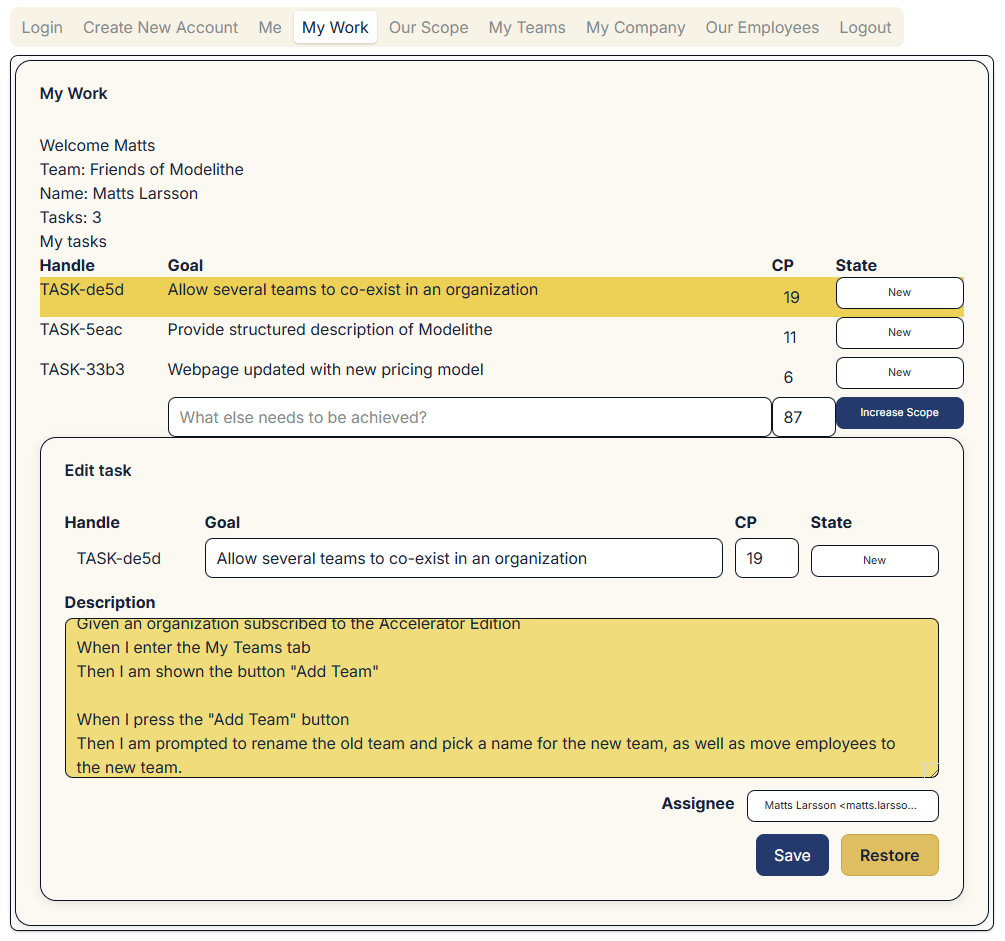
This tab lists all Tasks assigned to you, including their current state. There are no hidden abstractions, no ceremony, no complex configuration required before you can start.
To add a new Task:
- Go to My Work
- Write a clear Goal description in the text entry box
- Optionally adjust Complexity Points
- Press Increase Scope
The Task is automatically assigned to you.
That’s it.
No separate sprint planning screen. No detached backlog ceremony. No artificial distinction between “bug report” and “feature.” A Task can represent a defect, an improvement, refactoring work, or any actionable engineering goal.
A task can even represent “Learn something about a specific subject” and other tasks that don’t produce any value apart from in the mind of the individual. But naturally, it is recommended that the outcome of such task is documented somehow.
For small teams, this simplicity makes Modelithe a highly efficient issue tracker tool and bug reporting tool with almost zero onboarding friction.
Task States by Edition
Modelithe scales states according to your edition.
Personal Edition
- New
- In Progress
- Approved
- Discarded
Founders Edition and Above
- Under Review
- Under Test
Accelerator Edition
- Accepted
- Ready for Review
- Ready for Test
Lower tiers focus on execution clarity. Higher tiers introduce controlled handoffs, quality gates, and structured review workflows — turning Modelithe into a lightweight but powerful defect tracking tool for growing organizations.
Complexity Points: Engineering Reality, Not Guesswork
Modelithe uses Complexity Points (CP).
They resemble Story Points in Scrum or XP — but with critical differences.
The Problem with Traditional Story Points
In many teams, Story Points quietly degrade into:
- Man-days
- Calendar days
- Or arbitrary velocity numbers detached from real effort
This leads to distorted planning, unrealistic expectations, and confusion between duration and workload.
Some work items require little hands-on effort but stretch over time due to waiting, dependencies, or review cycles. Traditional point systems rarely model this correctly.
The Modelithe Approach
Modelithe uses a modified Fibonacci sequence. One Complexity Point can be approximated to one focused working hour at 100% allocation.
However:
Team capacity is dynamically adjusted based on how many parallel projects each team member is involved in. This prevents the illusion that a person can be fully allocated to multiple streams simultaneously, and it also takes into consideration that a person split over several projects is less efficient than if the person works focused.
It is a structurally grounded alternative to conventional bug tracking tools and issue tracking tools that ignore real-world allocation constraints.
Guardrails That Prevent Estimation Drift
Modelithe does not forbid mistakes. It makes you aware of them.
If you enter:
- 5 CP or less → Warning:
“CP is to be thought of as HOURS, not days. Are you sure?” - 32–87 CP → Warning:
“Don’t forget to consider testing, buffer and queue time!” - Above 87 CP → Warning + confirmation:
“Way more than two weeks of work; consider breaking down the task?”
There is no warning if the default value (87) is untouched.
This ensures iteration planning forces an explicit discussion when it matters, without creating friction during capture.
The result is a more disciplined bug tracker system that nudges engineering judgment instead of enforcing rigid bureaucracy.
Modelithe do not prescribe how to estimate a Task. You are free to use planning poker, guesstimates or rigid prestudies as you see fits the problem best.
Working on a Task
To start working:
- Click the status button
- Select Start Progress
If the Complexity Points were never defined, the system forces you to set a reasonable value before proceeding.
This avoids the common failure mode in many bug tracker software systems where tasks move through the workflow without realistic effort assessment.
To finish:
- Click the status button
- Select Approve
“Approve” replaces the simplistic notion of “Done.”
Modelithe acknowledges that “done” is subjective.
In higher tiers, you can define rules such as:
- At least one additional person must approve
- Review is mandatory before closure
- Testing state required before acceptance
This makes Modelithe a scalable bug tracking software solution without enforcing heavyweight enterprise frameworks.
Reopen or Discard — Explicitly
If a Task needs to be reopened:
- Click Reconsider
- It returns to New
If a Task becomes unnecessary:
- Click Discard
- Optionally add an explanation
- Confirm
In higher tiers, explanations can be:
- Mandatory
- Optional
- Disabled
This explicit lifecycle prevents silent deletion and supports traceability — critical for teams using Modelithe as their primary issue tracking software and structured bug tracking system.
More Than a Bug Tracker
Modelithe works as:
- A bug reporting tool for capturing defects quickly
- A defect tracking tool with structured approval workflows
- A scalable issue tracking tool for cross-team coordination
- A disciplined bug tracker system for engineering organizations that value transparency without overhead.
But it is not built around “bugs.”
It is built around Goals. A bug is just another Task that have been identified before or after the delivered goal of another Task had been Approved. There’s nothing magic about bugs apart from not being planned.
Every Task describes a concrete outcome. Every outcome consumes real capacity. Every capacity assumption is visible and structurally constrained.
That is the difference.
Why Modelithe Works
Modelithe succeeds because it enforces three principles:
- Capture work where it happens — in My Work
- Model effort realistically — using Complexity Points
- Scale workflow only when organizational complexity demands it
It avoids the trap of over-designed bug tracking tools while remaining powerful enough to function as enterprise-grade issue tracking software when your organization grows.
If you need a modern bug tracker tool that respects engineering reality, prevents estimation drift, and grows from solo development to coordinated multi-team delivery — Modelithe was designed precisely for that journey.